## By sea, then up the Rhône
In the year 6, Emperor Augustus exiled Archelaus, a son of King Herod, to Vienne on the Rhône. Josephus records it. In 576, according to Gregory of Tours, the bishop of Clermont gave the town's Jews a choice: baptism or departure. Those who refused went to Marseille.
## The oldest dated stone
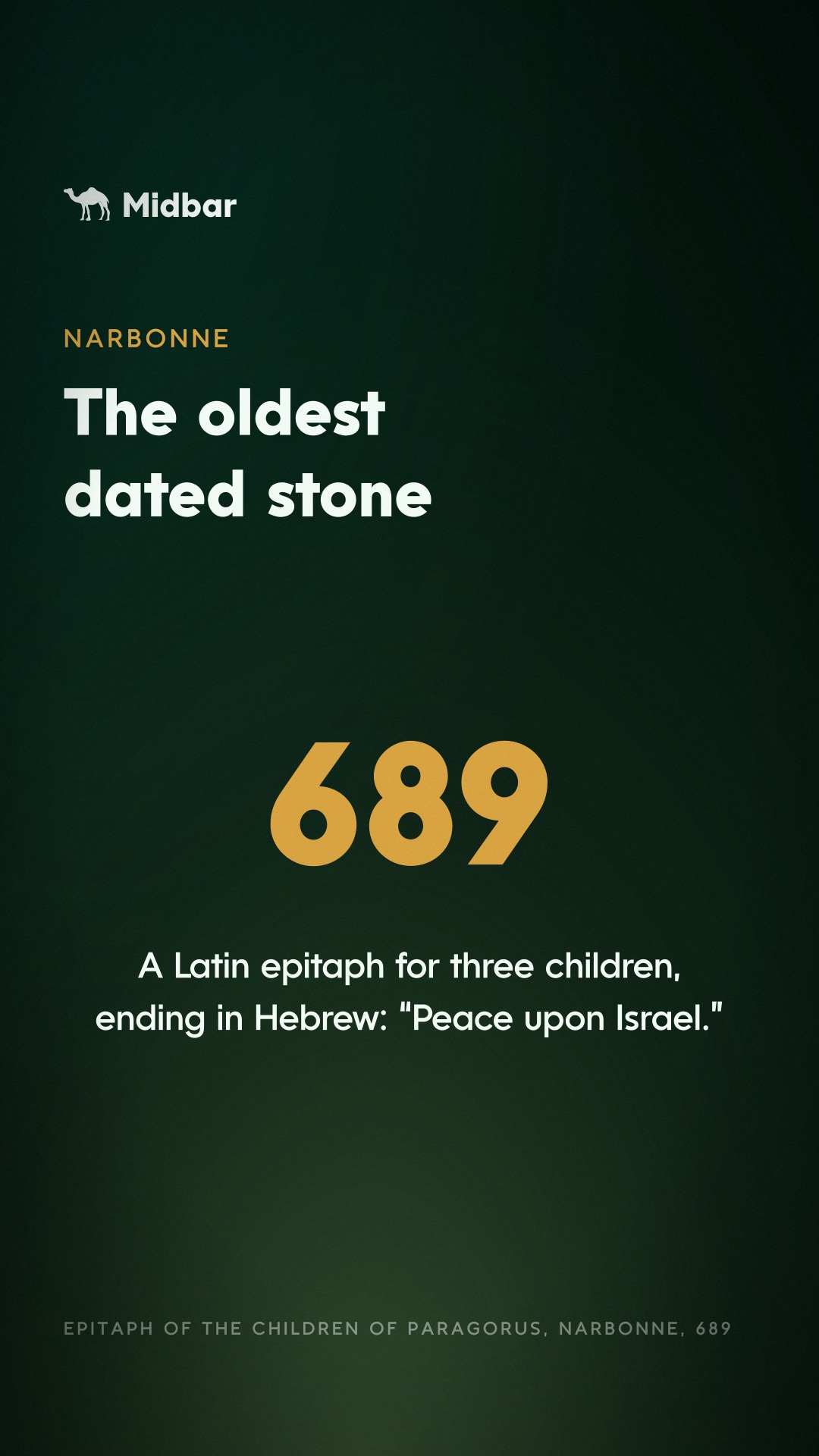
In Narbonne, a gravestone from 689 marks the burial of three children of a man named Paragorus. The epitaph is in Latin. It ends in Hebrew: shalom al Israel, peace upon Israel.
In Narbonne, a gravestone from 689 marks the burial of three children of a man named Paragorus.
In the eleventh century, in Troyes, Rashi (1040-1105) wrote the most widely read commentary on the Bible and the Talmud in Jewish history. It is still studied line by line. In the south, in Lunel, the Ibn Tibbon family translated from Arabic into Hebrew; Samuel ibn Tibbon gave Hebrew readers Maimonides' Guide of the Perplexed. Around 1180, the Bahir surfaced in Provence, and with Isaac the Blind the first Kabbalah took shape.
## The fire and the badge
After the Disputation of 1240, around 1242, the Talmud was burned on the Place de Grève in Paris: twenty-four cartloads of manuscripts, thousands of books copied by hand. In 1269, Louis IX ordered the Jews of the kingdom to wear the rouelle, a yellow cloth wheel sewn on the chest and on the back.
## Expelled, recalled, expelled
In 1306, Philip the Fair expelled the Jews from the kingdom and seized their property. Louis X recalled them in 1315; they were expelled again. In 1394, Charles VI made the expulsion final. Provence was not yet French. When it became so, its Jews were expelled in turn, between 1498 and 1501.
One corner stayed open: the papal lands around Avignon. Four communities, Avignon, Carpentras, Cavaillon and L'Isle-sur-la-Sorgue, lived there under the yellow hat, in a street locked at night, the carrière. But they stayed. The synagogue of Carpentras, first mentioned in 1367, is still in use today.
Next: citizens, then accused.